



Professor Jonathan Shepherd CBE is Professor Emeritus of Oral and Maxillofacial Surgery at Cardiff University. Early in his career, he found that most assaults treated in hospital were never reported to the police. He built the Cardiff Model to address this gap by combining anonymised A&E data with police data. This approach has helped cut violence by up to 60% across England and Wales. More recently, Professor Shepherd has focused on building the evidence ecosystem. He helped to create the What Works Centres, the College of Policing, and the Chartered College of Teaching.
Three takeaways from me from this episode were:
The value of a small team: Professor Shepherd discussed the importance of having fewer people in the room, each of whom could take action and get things done.
The evidence ecosystem - a phrase he coined. His goal is to put everything professionals need around them: evidence generation, professional standard-setting bodies, and regulators.
The consistency that one person can bring when public servants are coming and going all around: Professor Shepherd did that at Violence Prevention Board; receptionists do it on the ground.
We also discussed, how a randomised trial of pint glasses changed what the whole pub industry bought, turning A&E data into action to cut violence, how Theresa May added the last piece of the violence reduction puzzle, how the colleges of teaching and policing match up to the royal colleges of medicine, and how Richard Trevithick influenced his approach.
Professor Shepherd’s decades’ involvement in turning evidence into action make this a particularly fascinating interview.
You can listen to the interview on Spotify, or read the transcript, lightly edited for clarity, below.
I’d love to start with pint glasses, because it seems like a great example of the kind of work you do.
How did you get from a finding about the role of glass in assaults to a change in what the whole pub industry was buying?
This was a planned programme of advocacy and experiments. We discovered that glasses were a weapon in violence that hadn’t been identified before. The next question was: what kind of glass is used as a weapon most frequently? We did a survey on a busy bank holiday weekend across England and Wales, and found that it was the one-pint lager glass – straight-sided, with a bulge at the top, known as a nonic.
I thought: what’s the breakage resistance of these glasses? We set up an experiment in the dental materials lab and got samples from all the manufacturers of one-pint glasses. We found that one of the glass types from one particular manufacturer was almost impossible to break using our impactometer. It turned out that it had been toughened – tempered – in the manufacturing process.
These things are always a series of steps, both for experimentation and for advocacy and achieving impact. The next step was to carry out a randomised trial of toughened glasses in 57 pubs in the West Midlands and South Wales. All the pint stocks in those pubs were switched either to toughened or non-toughened glass. The result was a 60% reduction in injury risk associated with the tougher glasses.
The next step was to get that published in a journal which is widely covered by the media. We chose the British Medical Journal’s specialist journal, Injury Prevention. That produced a substantial amount of media interest: I remember the yellow stickers from each media outlet plastering the door of my study in the hospital.
Did you have all these steps clear in your mind at the start?
It wasn’t clear to start with. Just asking, from the original finding, the bank holiday research, what’s the next step? That led us to the materials laboratory work, then the randomised trial, and then the advocacy after that.
I believe that led to a substantial fall in injuries caused by glass nationwide?
It did. Home Office analysts estimated that this reduced the number of glass assaults by around 40,000 a year in England and Wales. That was the lower bound of their estimate – it was not absolutely precise, but it was clear that this was associated with a step reduction.
There was a lot of advocacy: I spent a lot of time with the media, the pub trade and the glass-manufacturing business. The important moment was the announcement in 1999 in The Licensee, the trade magazine for the pub trade. The headline was, “Industry Switches to Toughened Glass.”
The starting point for the Cardiff Model of Violence Prevention was your discovery, as part of your PhD, that most violence treated in hospitals wasn’t known to the police – because victims were scared, didn’t know what had happened, or were unwilling to face scrutiny of their own behaviour.
How were you able to share this data with the police while maintaining patients’ trust and confidentiality?
The Cardiff Model does not depend on the sharing of personal information. All the information is anonymised before it leaves the hospital. In 30 years, we’ve not had one complaint, or even a question about confidentiality. The Information Commissioner has reviewed this twice, and it has obtained ethics committee approval.
When the patrons of pubs in Cardiff were asked, “How do you feel about the local A&E monitoring which licensed premises violence happens in, and then taking action to make those premises safer?”, there was widespread support. People want to know where it’s safe to go out in the city centre.
In 2000, you published a list of the 10 most violent pubs in Cardiff. What happened next?
That involved a two-page article in the Western Mail, the main newspaper in Wales. Around the edges of the article were the quotes from the interviews I’ve just mentioned with the pub patrons. There was a very helpful result: all of a sudden, the licensees realised that their premises were being scrutinised. They got together and established a licensees’ forum in Cardiff, to make sure that their voice was heard. That was a very positive move, and it was supported by South Wales Police.
We then invited the chair of the licensees’ forum, a prominent licensee in the centre of Cardiff, to join the violence prevention group – not for the purpose of creating policy, but to make sure that information about prevention was relayed from the group to the licensees in an organised way. That relationship has been very good ever since, and continues to this day.
The board brings together agencies including health, the police and the local authority.
Tell us about the first meeting: who was in the room, what did you ask them to do, and how did they respond?
The first meeting was in July 1996. I convened it because I thought we needed a mechanism for turning this data – A&E and police data combined – into practical prevention. I thought the best way to do that – and so it proved - was to get executives from the police, local government, health and, at that time, the national charity Victim Support to meet. I posed the question, “Do you think we could reduce violence more effectively using A&E and police data combined than we can with what is obviously very incomplete police data?” That became Cardiff’s Violence Prevention Group, which has been meeting ever since. I chaired it for two decades, until 2018. An A&E consultant colleague of mine and the head of the Violence Prevention Unit for Wales have co-chaired it since.
The group to turn the evidence into practical prevention is one of the two new ingredients that the Cardiff Model uses. Secondly, the data from A&E. These are particular data items:
The specific location – a named school, park, street, pub or licensed premises
What weapon was used
How many assailants there were, because we realised that more than one assailant is often a signal of gang violence
The relationship between the victim and the person who harmed them – we used the same categories as the Crime Survey for England and Wales
That information is collected by the emergency department receptionist and shared with the police.
Who does the collating?
The data is recorded by the receptionists, it’s analysed and cleaned up by the IT unit in the health board – the NHS trust, in England. It’s then shared with around 30 people: analysts and others in the local authority, the police and public health. The analyst is in the local authority, Cardiff County Council.
Over the following years, we see this sharp divergence between violent injuries in Cardiff and those in similar UK cities. It seems to have been an iterative process: you tested things like phone lines and victim support, which didn’t work so well, and pedestrianisation and CCTV, which did.
How easy was it to get people to stop doing things that didn’t work?
Victim Support turned out not to be a contributor to violence prevention, so they left the group. Their role is different: it’s to support people who are injured, not primarily prevention.
Reflecting on these data, we decided to institute a policy, led by South Wales Police, called Cardiff After Dark. At peak times, at night and at the weekend, that involved pulling police officers away from leafy suburbs in north Cardiff, where there’s hardly any crime and certainly very little violence, into the city centre. Then, rather than having police patrols which weren’t very well directed, the patrol routes were directed so that they always included the hotspots: hot premises and locations where violence took place.
Another example is putting up CCTV cameras in street locations which weren’t covered before, where the A&E data showed that there was a hotspot. The bottom of Bute Street, in the old Tiger Bay area of Cardiff, is one example.
The switches in policy reflected interventions which are known to work, rather than making things up on the back of an envelope. That’s why the violence prevention group has always had strong links with the Violence Research Group at Cardiff University, which I also headed over the same period. A professor colleague of mine has taken over that role now. That has a two-way advantage. It allows the research group to evaluate new ideas which come from the practical work in the city, and it enables the violence prevention activity to be informed by what works.
There was an outbreak of homophobic violence in a couple of parks in the centre of Cardiff. The solution, we thought, was to collaborate with the city parks department and cut down the shrubbery to increase natural surveillance. Clearing the hiding places, and the public’s view of those spaces, pretty much eliminated that problem. It was really striking.
Do I picture the executives on the board sitting down with a toolkit of evidence-informed methods and matching them to problems, or do they hand problems down to local teams to choose?
It’s important that the executives on that group have the authority to change things. There’s a senior police officer who has the authority to change police patrol routes and manage Cardiff After Dark. It’s important to have a city alcohol licensing manager who can change licensing conditions, and even close places where violence is continuing without any control. It’s down to those individual agencies, but the power, or the prompt, comes from the executives on the board.
The toolkits have only been developed recently. The College of Policing Crime Reduction Toolkit has only been in place for a few years, and the Youth Endowment Fund’s toolkit for a couple of years. Over the first 25 years, there were no toolkits available. But people in the research group know the literature about whether street CCTV works – yes, it does, to reduce violence. Then there’s the data about toughened glasses. The voluntary, church-based street pastors became, to use the criminology term, the “capable guardians” in the city centre when people were most at risk. That’s a sound criminological theory, and that was before any toolkit was available.
Two decades is a long time to chair the board for. Sometimes partner organisations’ enthusiasm waxes and wanes – you don’t get the superintendent, you get a chief inspector instead.
Was buy-in maintained because people were seeing results, or were they points where you had to intervene?
The inspiration for me to keep going came from the engineers. One of my interests is the Industrial Revolution and its pioneers. Richard Trevithick was the first person to put a powered vehicle on a railway line or a road anywhere in the world. But he gave up after four or five years, and shot off to South America to put his steam engines into the silver mines there. Whereas the Stephensons, George and Robert, carried on from one thing to another.
I thought, “There’s a real lesson from Richard Trevithick, Shepherd, and that is that you keep going. Don’t stop, because change takes a long time – systematic change in particular.” That was a major prompt to me, because there’s all this churn. Local government officials, police executives and health colleagues swap jobs quite often, so it’s important there’s continuity. I thought, “I can provide that continuity.” It wasn’t perfect, and we still had the churn. I look back and think I should probably have been a bit more assertive on occasion. But that continuity certainly resulted in some very good things over the years.
I was quite taken by your description of a data manager at St George’s Hospital saying they won’t keep sharing the data – and you get it into the Evening Standard straight away.
You provided the continuity, but what kind of tools are you using to keep the engine running?
The A&E receptionists are key to recording these data. I thought, let’s see if we can persuade the Chief Constable of South Wales Police to give the head receptionist at the University Hospital of Wales in Cardiff a certificate, to celebrate her and her team’s important contributions to implementing the Cardiff Model. I noticed that she put that certificate up above her workstation, and it stayed there: she was really proud. Acknowledging people in that straightforward, personable way can be motivating.
Another way was to make sure everybody knew where Cardiff was in its Home Office family of most similar cities. In 2007, Cardiff became the safest city in its Home Office-designated family of most similar cities across England and Wales.
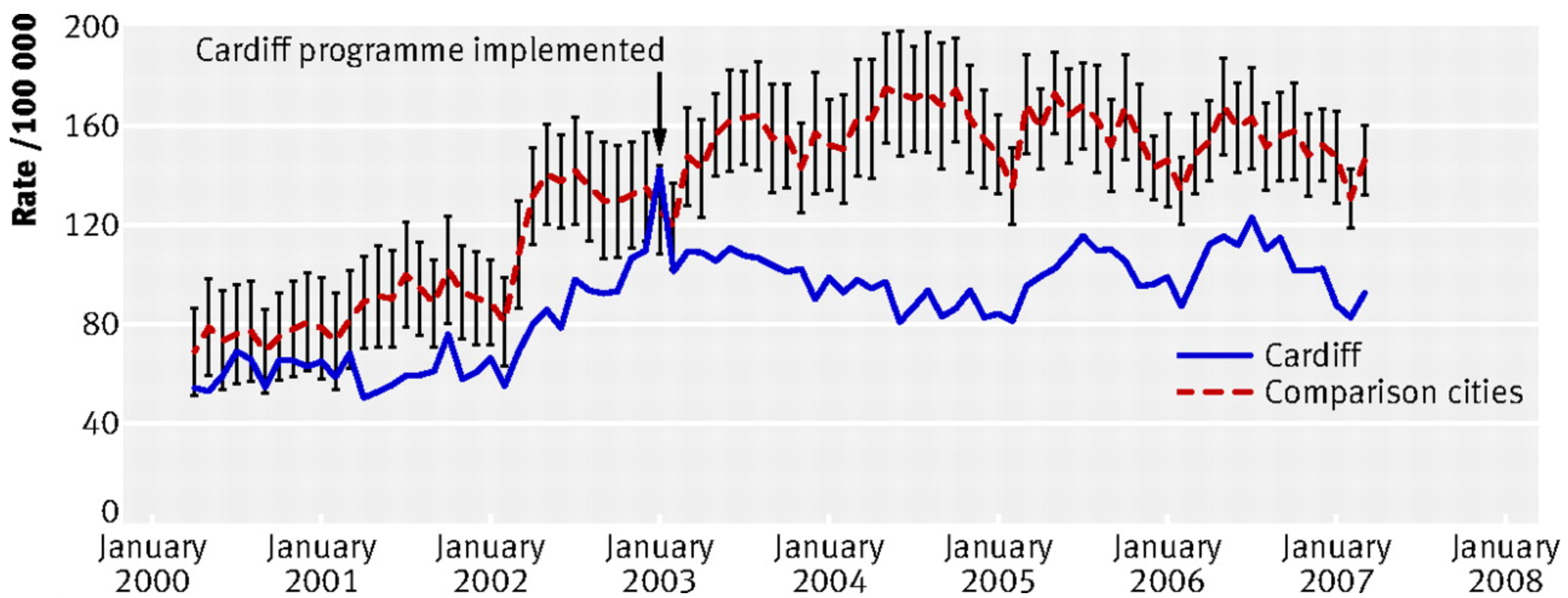
We kept everybody’s eyes in the group on where we were, in our quarterly or two-monthly meetings. We like competition. We want to be the safest city; we’re proud of that, and it remains the case. We were vying with Sheffield for the lowest rate of serious violence. That competition, and keeping people’s eyes on where we were, also resulted in the Home Office identifying Cardiff as particularly safe, and South Wales Police got a pat on the back. That’s happened a few times over the last ten years: the South Wales Police area was identified by the Home Office as what they called a “positive outlier”. It took me a while to understand what that meant, but it was good.
By the time a data manager at St George’s Hospital in south-west London decided that she’d stop sharing the data, the Cardiff Model had been established in London for quite a few years. It remains the case that all 29 A&Es in London are sharing these data, and they’re being used for violence reduction. I was shocked at this. At the same time, St George’s Hospital Trust published a warning to all its staff to be careful about violence on the way to the hospital. I thought, “These things are probably linked.” If you reduce safety by stopping data sharing, it’s not surprising that the staff are at greater risk.
By that time, I knew the crime correspondent on the Evening Standard. Also, I’m not politically aligned, but I’d got to know the Liberal Democrat member of the London Assembly. The Standard went to her and said, “What do you think about this? They’ve stopped sharing the data.” She gave an amazing quote: “This is shocking. This is putting people at risk in south-west London, and it’s for no reason at all.” Within a week of that article being published, St George’s Hospital was sharing those data again.
You’ve written about being asked to shift the board’s principal focus away from violence in general towards issues such as violence against women and girls – even though men and boys are the larger proportion of victims.
How did you maintain that focus?
The Cardiff Model doesn’t target a particular age group or gender. Whether you’re a nine-month-old baby or a 90-year-old, if you get injured in violence and you come to an A&E for treatment, you’re included. It’s a classic public health approach. That has an advantage: the last time I looked, there were getting on for 50 different offences on the statute book under the violence heading. Trying to put together a strategy for each of those is hugely costly for the public purse, and things become unfocused very quickly. Having this universal approach helps keep things in perspective.
On violence against women and girls, the data is all anonymised: information about women and girls – where they live, their contact details – is not shared at all. The role of the hospital becomes very important there, because it has the data. It would be irresponsible for the care package of women and girls in, say, domestic abuse not to include measures designed to reduce their risk of repeat harm: multi-agency risk assessment conferences, refuge accommodation, having nurses get alongside the injured to look at their vulnerabilities and try their best to reduce those risks. Again, those are evidence-based approaches, but that’s the hospital’s job. It doesn’t involve information sharing which would identify to the police, or any other external agency, who they are or where they live.
The Cardiff Model has spread. It’s used in London, parts of it have moved into law and policy nationally, and it’s in Australia, the Netherlands, South Africa and the United States.
How faithful has implementation been? If I’m a receptionist in Cardiff and go on holiday to Australia, would I recognise the same practices?
It’s hard to know precisely where it’s been implemented. In Australia, there have now been three published evaluations – in a rural setting, and in Melbourne and Sydney – and another adoption is just starting in Western Australia, based in Perth. I can’t tell you precisely, because I haven’t had a conversation with receptionists in those places for a while, but it was certainly implemented and, as far as I’m aware, continues to be. In Australia, so far, the Cardiff Model has been implemented there more in relation to dealing with intoxication – identifying where drunk people have had their last drink, and premises which are serving drunk people more alcohol – than for violence prevention.
In the United States, the people who collect these data are more likely to be triage nurses than receptionists. A problem arose in COVID, when A&E nurses were reallocated to look after patients on the wards. To maintain continuity in the UK, the role of the receptionist in recording the data is important. They weren’t redeployed in COVID at all: they stayed doing the same old job in the same old place. They’re one of the most stable parts of the NHS workforce.
There are some places in the United States which have been doing this for a few years now: Atlanta, Milwaukee, and other places in Georgia. But they face the same problems: the churn of staff, and legislation which isn’t as good as it is here, where the Crime and Disorder Act mandates joint agency prevention. In the States, there’s no such legislation.
It took until 2020 for the last piece of the puzzle in England and Wales - ensuring emergency departments had a field for recording the precise location of violence.
Why did it take so long?
I’ve come to the conclusion that it’s just in the nature. It goes back to sticking at it and not giving up. There was a big breakthrough in 2014, when NHS Digital published the Cardiff Model data [standard]. They called it ISTV: Information Sharing to Tackle Violence. But the difficulty was that there was no mechanism for recording the precise location of violence – a named pub, or park, or school.
One of the challenges was that the Department of Health can’t tell the Home Office what to do, and the Home Office can’t tell the Department of Health to make sure that these data are recorded in A&Es, because that’s not a Home Office responsibility. It took the Prime Minister’s summit, chaired by Theresa May - the directive came from the top, from Number 10. As a result, a free-text field was created and put into the new Emergency Care Data Set, for the receptionist to record the precise location of violence. Prime Minister’s summits don’t happen very often, so that explains why it took so long.
You’ve written that, as the model has spread, the step most often skipped is using the data – which seems surprising, given the effort it takes to get it collected and standardised.
Why do you think that is?
One of the reasons is that people don’t easily get the need for a small group of executives in a city to make sure the data is translated into prevention practice. People think, “We should get the probation service,” and, “What about Women’s Aid?” and, “What about X, Y, Z?” All of a sudden you’ve got a room of 15 people, and it becomes a talk shop. It’s not action-orientated. This has certainly happened in the United States. People think, “It’s bound to be better if we include X organisation.” I have to say, “No, it’s not. It’s going to make it worse, because you’re going to move from a focused prevention activity to endless discussion, with everybody trying to become an amateur criminologist when that’s not necessary.”
Sometimes, and particularly in the States, there is pushback from the police. The police chief will say, “What’s health got to do with this? It’s my job to prevent violence..” There’s resistance to collaborating on this in a streamlined, efficient way.
There can be a big pushback from the alcohol industry, because they want to protect their business. They’re a powerful lobby, and they can object on business grounds to conditions being put on alcohol licences, to do with opening hours or whatever it is.
In the NHS, there can be – not pushback exactly, but the care of the patient, and dealing with their injury and the harm that’s been caused, comes first, quite rightly. The prevention aspect can become rather secondary, and drop off the radar if you’re not careful.
If I was starting a violence prevention board in a city tomorrow, how many people do I want, and who should they be?
It should include:
A local government executive, who has the authority to change alcohol licensing, to pedestrianise streets where the pub trade is focused, and to intervene in schools through their education links. Often they’re also responsible for putting up and managing CCTV systems.
A police executive, of at least superintendent level, who can switch patrol routes.
Somebody from public health, who has responsibility for the health of the population – and the authority, in the same way that they would with vaccination programmes.
Somebody from A&E, who needs to be a consultant: a senior emergency physician with a permanent appointment, who can liaise on a daily basis with the receptionists to make sure the quality of the data is up to snuff.
Where it’s a city with a university with a strong research interest in criminology or crime prevention, having someone there who can talk about what works and what doesn’t is very helpful.
The analyst – whoever is analysing the data and putting hotspot maps together – is crucially important. It’s not a backroom function; it’s a front-row function: somebody who can brief the group every time it meets on where the latest hotspots are.
I think someone from education as well. Over the years, schools and routes to school have become important locations for violence prevention.
That’s about six people.
Funding was cut in Cardiff in the late 2000s and early 2010s, and I think the analysts were removed. What survived from that era of austerity?
They weren’t removed, it was a threat. It got as far as the analyst feeling that he was losing his job but, with advocacy, that didn’t happen, so the continuity was maintained. But the austerity years meant that, not just in Cardiff, a lot of funding was taken out of community safety partnerships, which is the statutory mechanism for reducing crime of all types – not just violence, but acquisitive crime such as theft and burglary, and antisocial behaviour. In Cardiff, the whole team was laid off, and the responsibilities of the community safety partnership went to the local public services board, which includes the chief executives of the local authority and the NHS trust, and the police chief of the city, who is at chief superintendent level. It was a struggle to keep things going through that period, but it was maintained.
But that affected everywhere else across the country as well. I remember going to a high-level meeting in about 2015, and hearing somebody say, “We don’t have any analysts any more: austerity has put paid to all those posts in my authority.” As a result, violence started to go up again in the 2010s, including knife crime. That was the reason for the Grip funding for extra police patrols from the Home Office, and the creation of violence reduction units in 20 police force areas, which is just under half of them.
There was a renewed focus on this. The Home Secretary, Sajid Javid, signed the Home Office’s impact assessment in 2019, which said that if just 5% of local-authority areas implemented the model, the savings over 10 years would be £858 million. You’d like to think that made a big impact on policy. It didn’t make as big an impact as we’d like, but it certainly prompted the Home Office to fund a national programme designed to enhance the standard of data recording in A&Es. That was done through the A&E doctors’ professional body, the Royal College of Emergency Medicine, and was put in place a couple of years ago.
Do you see the Cardiff Model, or lessons from it, continuing to be applied effectively across England and Wales, or has the momentum slipped?
The very good news is that violence has come down substantially. There are 60% fewer A&E attendances for treatment of injuries sustained in violence than there were in 2000. It’s very difficult to know exactly what proportion of that you could attribute to Cardiff Model implementation.
There is the risk that people will take their eye off the ball, as they did in the financial crisis in 2008–09, and that there will be disinvestment in things that work. The public finances are under significant pressure. If a policymaker says, “Violence has decreased by 60% since 2000” – and the crime survey as well as A&E data confirm that – there’s a risk that the investment may not continue as it has done. The continuation of like the Youth Endowment Fund - whose endowment comes to an end in a couple of years - if that’s not re-endowed, that would, in my opinion, undermine violence prevention efforts.
Reminders are always important: keeping A&Es and the NHS engaged through conferences and through their professional body, the Royal College of Emergency Medicine, and through policing. One of the things that has helped is the College of Policing’s toolkit, which includes the Cardiff Model. They call it a violence observatory, because that was the title of a systematic review of evidence of Cardiff Model effectiveness. That toolkit, and the toolkit published by the Youth Endowment Fund, will help with continuity and maintaining this effort. It’s classic public health: we know it works. Tragic events happen from time to time – there are murders and tragedies like that – and I think it would be irresponsible for agencies whose responsibilities include violence prevention not to use those tragic events to underline how important this is.
I often picture the evidence-informed policy pipeline as a series of different figures: a researcher doing research, an advocate taking that research and pushing for change, a policymaker turning that into law or regulation, and then agencies that make it happen. When I look at your career, it feels like we haven’t had that model, and you’ve had a hand in every step: with the glasses, you were finding the issue, working in the lab, and talking to the pub trade.
Does the model work better if one person is overseeing every step? Does it work at all if there are gaps between the different figures?
That’s a great question, which I hadn’t considered before. With violence reduction, I think it does, but it devolves to cities and community safety partnerships to provide that overview. The violence reduction units have helped with that strategic overview of data into prevention.
I asked AI the other day who coined the term “the evidence ecosystem”, and the answer came back, “You did.” That was in my 2014 report for the Cabinet Office - that was the first time that that phrase was ever used. I’m rather pleased that that’s the case. I think it is useful for that system to be seen as a system – just like Al Blumstein coined the term “the criminal justice system”. The term “the evidence ecosystem” is informative in itself because, as you say, it joins together:
Evidence generation,
Systematic reviews, the distillation of the evidence,
The translation of that distilled evidence into guidance;
And then the crucial step of making sure that guidance is heeded – that public services respond to it.
I’ve just read a summary which ends with the question: who is responsible for implementation? My answer is that the inspectorates should be. His Majesty’s Inspectorate of Constabulary should expect forces to respond promptly to guidance published by the College of Policing, in the same way that the Care Quality Commission should expect hospitals, dental practices and care homes to respond promptly to guidance published by the National Institute for Health and Care Excellence (NICE). The same goes for Ofsted’s expectation of schools responding to Education Endowment Foundation (EEF) guidance: the EEF is the NICE equivalent in education. That’s the main focus of my thinking and work at the moment.
We’ve had two inspectorate roundtables so far, in London, chaired by the Director of the Office for Statistics Regulation – the inspectorate for statistics – so we’re slowly getting there. Services need to have powerful levers applied to get them to respond promptly to the most authoritative guidance we have, which is the guidance published by the What Works Centres.
To go back through the history of this: it was when I was chairing Cardiff’s Violence Prevention Group, and I thought about the cop on the other side of the table. For me, my professional home is the Royal College of Surgeons. We have NICE, which publishes guidance which I’m expected to follow or take full account of. We have the Medical Research Council (MRC), which provides funding for high-quality evaluation. But the police don’t have any of those things, and the same goes for some of the other sectors. I put a paper together that was published in Evidence & Policy, proposing that organisations equivalent to NICE were put in place in the other major services, such as education and policing. I called them Excellence Institutes; it was someone else who coined the term What Works Centres. I said in my article that it would be very useful if they had a forum in which they could share expertise about evidence.
Then I thought, “Come on, that’s not good enough.” I wrote to the Economic and Social Research Council (ESRC) and said that it seemed important to me to get the evidence it was funding taken notice of. That resulted in a meeting with Sir Adrian Smith, who has just demitted as President of the Royal Society but at that time was a director general at the Department for Business. When we met, he said, “We need to get this to the Institute for Government.” That prompted a roundtable conference at the Institute for Government, chaired by David Willetts, the then science minister. As a result, the What Works Centres, and the What Works Council which brings them together, were formed. I served on the What Works Council in the Cabinet Office from 2013 until 2020.
At the end of that time, when my term was coming to an end, I wrote the second report – Evidence and Guidance for Better Public Services – where I proposed that the inspectorates include responses to What Works guidance in their inspections. That’s the focus of the discussion with the inspectorates now. So that covered the range from evaluation through to implementation - basically creating the system. You’ve already got the term evidence ecosystem, but if you haven’t got the bits in there to make it happen – like with an oil refinery – you might as well not have invented the term.
You were involved in creating both the College of Policing and the Chartered College of Teaching and the Probation Institute. The College of Policing is Home Office-staffed, has a senior appointee, and sets authorised professional practice; the Chartered College of Teaching is a membership organisation and has a more open journal.
How would you contrast their impact on their professions?
There was dissatisfaction in the old National Policing Improvement Agency, and I wrote articles saying the police need a professional body, just like the surgeons. Surgeons and police have a lot in common: they’re action-orientated professions. Theresa May thought that was a good idea, and I served on the board that put the College of Policing together. For me, the police have professionalised a great deal as a result. The hoops you’ve got to jump through – the examinations and testing that officers go through to get from sergeant to inspector and so on – have helped a lot. I think the Code of Ethics they’ve published has been really helpful. The police get a lot of stick, and from the media you’d think they were going downhill. But from my perspective, and that of a lot of other people, the college has done an awful lot to professionalise the police service.
Let me tell you how the Chartered College of Teaching happened. One of the members of the House of Commons Education Select Committee was Charlotte Leslie, the MP for Bristol North West. Her dad was a consultant surgeon. When they were talking about professionalising teaching, she said to the committee, “Why isn’t there a professional body for teachers?” That came out in a report of the Education Select Committee. She then went to the Royal College of Surgeons and said, “Can you recommend somebody who can come and talk to teachers and leaders about the role and benefits of having a professional body?”
The College of Surgeons knew that I’d prompted the College of Policing, so they nominated me. I went along to Portcullis House and spoke to Charlotte Leslie and three or four other leaders and union heads, and said, “This is what the College of Surgeons does for surgery.” Of course, I was speaking to a receptive ear in that MP. That prompted a wider meeting of about 60 or 70 people in the teaching profession, at which I talked about this. That in turn prompted the Prince’s Teaching Institute Commission, which I served on. That produced the blueprint for the Chartered College of Teaching, which started in around 2017.
I was privileged to be on the inaugural council, and chaired its research and journal committee. Just like the College of Surgeons, but unlike the College of Policing, the Chartered College produced a journal, which you referred to earlier, Impact – and another, the equivalent of the Royal College of Surgeons’ Bulletin, which is more an update on things happening, with viewpoints for people in teaching to put forward.
One of the things the Chartered College of Teaching adopted from the College of Surgeons was to charge a fee. If you’re a member, it’s about £60 a year, and if you’re a fellow, it’s about £80–£90 a year. The College of Policing doesn’t levy a fee for officers to be members, so that’s a difference. I think the fee helps, because it gives teachers a voice in their own professional body. They’re all standard-setting bodies: whether it’s the Royal Town Planning Institute, the Royal College of Surgeons, the Chartered College of Teaching or the Royal Institute of British Architects. They all organise examinations for people who want to get their qualifications to be a consultant in the NHS, say.
But I could be a teacher and not a member of the Chartered College – whereas, as a surgeon, you must be a member of your college?
That’s right. You couldn’t become a consultant orthopaedic surgeon unless you were a fellow of one of the royal colleges and had passed the exams. It reflects the evolution of the professions: that’s always been the case in medicine, but there hasn’t been a professional body for teachers. It’s the same in the police: you can’t be a chief superintendent unless you pass the relevant College of Policing exams. To be a fellow of the Chartered College of Teaching, you’ve got to meet a number of conditions – a portfolio of work and that kind of thing – and I think it’s the same with being a member too.
I’m an enthusiast for getting more evidence into education - I’ve co-led a systematic review for the EEF, and sat on an advisory panel for one of its guidance reports. But NICE can say that if you provide treatment A health will be improved, and therefore you should do this. Those statements are harder to make in education and policing.
Is there enough evidence for a regulator to come in and say, “Why are you not doing X, Y and Z?”?
Policing’s certainly convinced of this, and that’s been clear at the two roundtables we’ve had. Probation’s the same: Martin Jones, the Chief Inspector of Probation, is very much behind this. If NICE decides that a certain treatment should be available on the NHS, by law it has to be in place within three months. That doesn’t apply to their guidance, though. The first NICE guidance ever published, in 2000, was about wisdom teeth – high volume.
The one you were involved in.
That’s right. But that’s not mandatory: there’s no obligation on the NHS not to remove wisdom teeth prophylactically. Nevertheless, if something goes wrong and you’re in court justifying why you did something and it was inconsistent with the NICE guidance, you’d be in trouble. There’s still a pretty powerful incentive to respond to guidance.
Guidance is guidance; it’s not diktat. In any profession – education, health, policing or whatever it is – there’s always got to be room for professional discretion. That is really important, because there may be good reasons why, in a particular case, guidance can’t or shouldn’t be followed. It’s not a tick-box exercise.
I think education is furthest behind with this. I’ve been corresponding with Georgia Gould, the Minister for School Standards. Ofsted doesn’t tell teachers and school leaders that EEF guidance is an example of “the best evidence available”, to quote them. I think that’s a real shame - it’s holding education back. The Department for Education says, “Ofsted is independent. Government has no place telling them what to do.” On the other hand, they tell Ofsted what to do in various other areas, so I don’t think they should be scared of doing it with this. The feeling I get in education is that the Department for Education thinks of the EEF as, “Just another charity in the education field. We don’t have to take what they say terribly seriously.” But these days, the What Works Centres are the evidence guardians in their sectors – and the EEF is funded very substantially by government.
In the roundtables so far, education is rather a laggard in all this at present, and it’s got some catching up to do. For example, EEF guidance says that small-group teaching enhances educational attainment, but neither Ofsted nor Estyn, in Wales, expects schools to implement it. It’s the same with sending text messages to parents about their children’s tests in the next week: that increases educational attainment, but neither Ofsted nor Estyn expects schools to do it.
Whereas in policing, if you’re breaching an authorised professional practice, you’d better have a very good reason.
That’s a good example.
Is there anything important that I’ve not asked about?
Years ago, I thought that a professions summit on evidence would be helpful. That happened at the Institution of Civil Engineers in 2013, and was chaired by Gus O’Donnell, the former Cabinet Secretary. There are many professional bodies: I think we had about 20 of them represented around the table to talk about the importance of evidence-informed practice.
The next thing I thought would be a good idea was to get those professional bodies to sign a declaration that they expected their members to take full account of evidence, and that their organisations would too. Nesta facilitated this for us and, in 2017, we had the declaration-signing event. I drafted the declaration, and it was signed by 28 professional bodies at a meeting at the Royal Society – again chaired by good old Gus O’Donnell. He was really keen on this agenda, so it was really kind of him to come and chair that.
That’s it. I thought: what can I do to create the system, and create the motivation for moving from one bit to the next?
You’ve written that data analysis wasn’t seen as essential in policing as it was in medicine, and much of what we’ve discussed - you can see the influence of a medical model and looking at other professions and seeing what they can do to catch up.
What else has your surgical background allowed you to see, or to do, as you’ve worked with other professions?
In my own specialty of maxillofacial surgery, when I started 40 years ago, the focus was randomised trials on painkillers – analgesics. The only other research people did was case reports: you’d see an unusual case, write it up and put it in a journal. I thought: I’m a practitioner academic, and I’m interested in violence prevention, so what about applying the same scientific methods to evaluating what happens in violence prevention? That’s the background to the glass randomised trial. Before I was interested in violence prevention, my research was all in bioscience – wound healing – so having a control group with experimental animals was second nature. I think that helped as well. I thought you couldn’t possibly do a randomised trial of glass – it sounds crackers, or difficult – but we did it.
Criminology has changed quite a lot in the last 30 or 40 years to be more quantitative. The criminologist I mentioned earlier, Al Blumstein, did a lot in the United States, because he came from a scientific background like me and was interested in processes. You’ll know that the EEF funded 200 randomised trials in its first 10 years. It’s fantastic. It’s happened more slowly in the other professions, but it’s been one of the big slow-burn changes in those professions over the last two to three decades. Again, you’ve got to keep at it. Things don’t happen suddenly. It’s about keeping going, and saying, “We think this is a better way to do it.”
A new police research funding arrangement came about at the same time as the College of Policing was set up: the Police Knowledge Fund. I proposed it. It’s easy, because I thought: we’ve got the MRC and the National Institute for Health Research in health, so the police need a pot of research funding that they can use. That’s happened. Slowly, slowly, we get there.
Looking ahead, assuming you’re continuing your non-Richard Trevithick model, what other pieces of the puzzle would you like to see come together over the next few years?
What I’d like to see in is the inspectorates all including responses to What Works Centre guidance in their inspection frameworks. That means inspecting what happens at the front line. It’s not good enough for a police force signing up to doing this if the superintendent in charge of policing in Cheltenham, Ipswich or Winchester doesn’t do it. Those inspection frameworks need to include inspection of decision-making at the front line.
It’s the same in health. It’s all very well for an NHS trust to say, “We sign up to NICE guidance,” if the consultants in their clinics don’t apply it and don’t respond to it. There are very few incentives for consultants on the front line in the NHS not to have a long waiting list. Anybody who does private practice knows that, if there’s a long waiting list, people are going to say – without the consultant saying anything at all – “Can I go private?”
It’s the same in dentistry. Dentists love six-monthly checkups, whereas the NICE guidance says the interval is up to two years for people with reasonable dental health. The research shows that six-monthly checkups are harmful, because they find more things for dentists to do. If capacity was freed up by moving away from routine six-monthly checkups, an awful lot of capacity would be freed up for people who can’t currently get NHS treatment.
We know from the research that financial incentives, including private practice in medicine, are persuasive. That stops consultants from doing what they could to reduce their waiting lists.
That’s why, if the Care Quality Commission, and Healthcare Inspectorate Wales in Wales, expected clinical audits of responses to NICE guidance in their inspections, that would do a lot. People take notice of the inspectorates: they have powerful levers, and I think that’s how they should be applied. It’s not to say that every consultant is like that. Many do the right thing and are dedicated to doing the right thing.


