


The results of PISA international tests, published in September, placed England as one of only two countries outside East Asia in the top ten in maths, reading and science. Originally a maths teacher, Mark Lehain has seen things improve first-hand:
Founding Bedford Free School in 2012,
Campaigning for education reform at Parents and Teachers for Excellence, the Centre for Policy Studies, and the New Schools Network,
As a special adviser at the Department for Education,
And as a parent.
He’s now executive headteacher of Wootton Academy Trust.
In this episode, we discussed what’s improved and why, how to open and improve a free school, how policy gets made at the Department for Education, and what has to stay in place in England to avoid following Finland’s decline. I got a new perspective on:
What to do, and what not to do, as a special adviser trying to get things done in government. He explained the importance of being perfectly aligned to what your minister wants done - “the moment people think you’re going off brief, you lose all credibility.”
The three purposes of the free school programme to create school places fast, to do it at lower cost, and to promote innovation - and its success in achieving all three.
The importance and rarity of ministerial continuity - and the very special role played by Nick Gibb.
We also discussed how a question from Gibb changed Mark’s mind about what mattered in education, what other countries can learn from school reforms in England, and why school culture is the key thing Mark hopes will survive whatever the political weather.
If you’re interested in learning more about school improvement in England over the last twenty years, I’ve interviewed many of the key figures, including Michael Gove, Nick Gibb, researcher Tim Oates, and multi-academy trust leader Dan Moynihan.
You still teach regularly. How does your teaching look different now from when you began?
I did my teacher training in 2002–03, at the peak of student-centred, student-directed learning and gimmickry. For my first years, I was very big on diamond nines, matching pairs, and games and puzzles for kids. You might have seen tables arranged in islands, where kids often have their faces looking away from the board. Like a lot of people, I discovered that didn’t work so well. After three or four years I was a very big fan of rows. I’m all about the kids being able to see the board, and about trying to make my handwriting on the board as neat as possible. I still struggle to lay out my workings in a coherent fashion, so that hasn’t changed.
I was a headteacher until 2017, then spent seven years in and around Westminster in different guises, and came back to this job at Wootton Academy Trust in the summer of 2024. One thing that hasn’t changed is the teenagers. They are as hilarious, frustrating, funny, and outrageous now as they were then. It’s nearly 25 years since I started teaching, and I don’t think the kids have changed that much – they probably haven’t changed that much since I was a youngster either. What’s interesting is the bits around them that have and haven’t changed.
You had a specific conversion moment, from a student-centred classroom to something more structured. Tell us about Nick Gibb’s visit to Bedford Free School.
There was a sliding-doors moment that changed the direction of my work and how I see things. The best thing about it is that a photo was taken just before that moment happened.
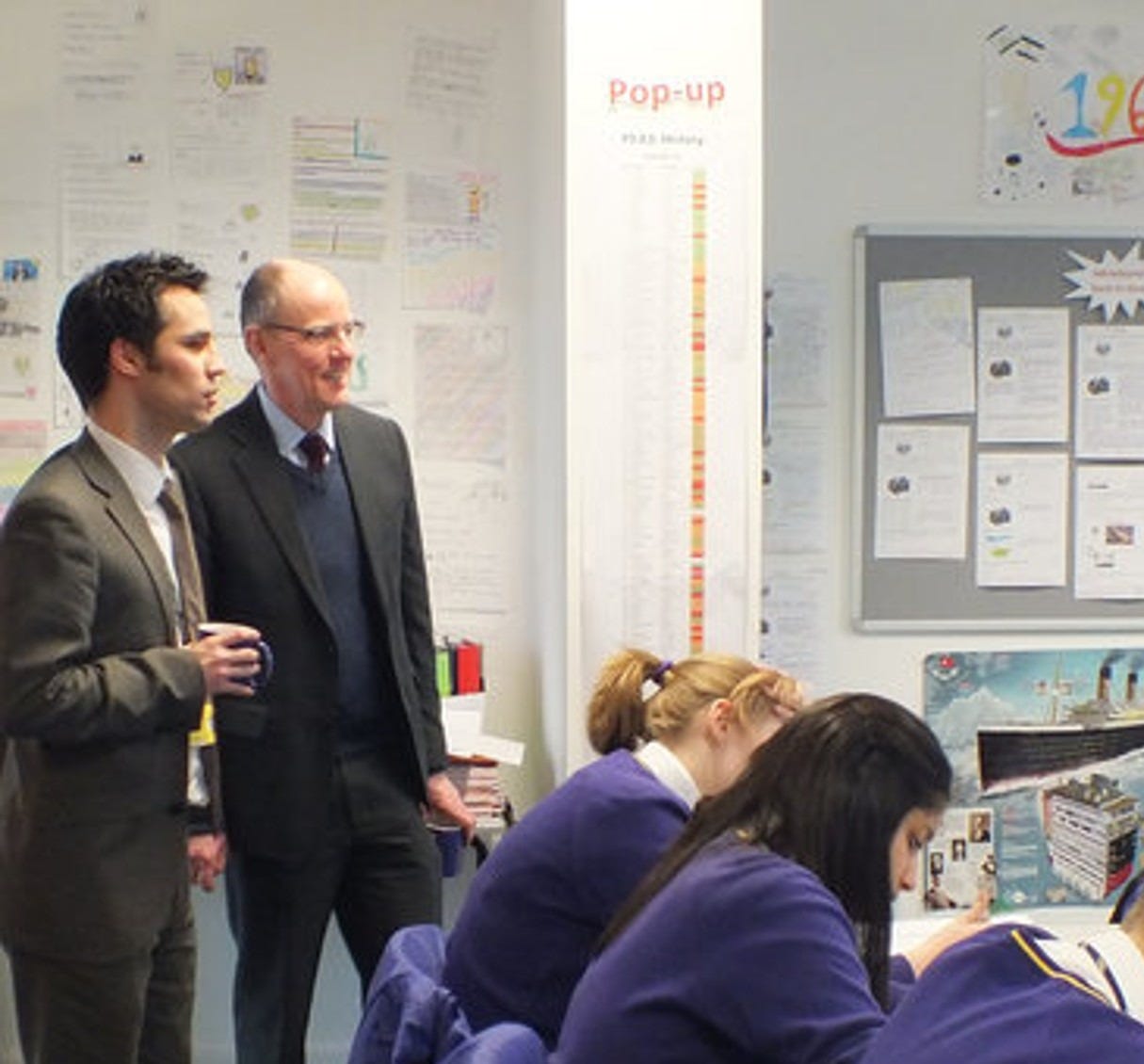
In 2014, Nick Gibb came to visit Bedford Free School. It was one of the brief periods in the last 15–20 years when he wasn’t the schools minister, but he still visited schools in his spare time. [I have interviewed Nick Gibb about his work as schools minister.] We were in our second year of operation. I’d shown him around, and he had just watched a geography lesson where some Year 10 kids were rapping about fair trade coffee. For those who know Nick Gibb, he’s not a massive fan of rapping lessons, although he probably doesn’t mind a fair trade coffee. As we left the classroom, he stopped in the corridor, turned to me and said, “That was all very nice, but if I’d asked them what the capital of Sudan was, would they have been able to tell me?”
I paused - I had to think - and gave some kind of fumbled answer. That evening, as I reflected on it, I realised I didn’t know two things: whether they would know what the capital of Sudan was, and whether they were meant to know. I didn’t know much about what my brilliant teachers at Bedford Free School were teaching – what was in the curriculum, or what order it was in. I spent the next few days getting my subject leads to send me their programmes of study. They were brilliant living documents; they had put loads of effort into them. But they were overwhelmingly focused on how the kids were going to learn and what activities they were going to do. There wasn’t so much focus on what they were going to be learning – the actual substance.
Nick followed it up with me not long afterwards. Like all the best evangelists, he gently nudged me towards some of the more accessible work. Before I knew it, I was reading E.D. Hirsch and Dan Willingham, and when Daisy Christodoulou’s Seven Myths about Education came out, I picked it up. He started pushing me down the knowledge-rich route, and I’m grateful for that, because it completely changed my views. He made me realise I didn’t understand what the substance of education was. It wasn’t quite a Damascene moment of blinding light, but he set me off on that journey.
In 2010 the Coalition created the legal structure for new free schools; Bedford Free School was among the first proposals approved, and opened in September 2012.
Why did you want to set up a free school?
So much of what I’ve been able to do was down to luck. The second person I met at university in 1997 dated someone who ended up working for some up-and-coming politicians, including Theresa May and Boris Johnson – but, most pertinently, Michael Gove, when he was Shadow Education Secretary. They introduced me to Rachel Wolf, who was just leaving Michael Gove’s team to set up the New Schools Network.
I remember meeting Rachel in the May half term of 2009, running across London late for this meeting with a double buggy, because I had my older two girls with me. She introduced me to the idea of free schools. “In America,” she said, “there are schools that people open, and lots of them are opened by groups of teachers.” A light bulb went on in my head. The idea was really cool. When I was explaining it to other people, I said, “Lawyers set up legal practices and accountants set up accountancy firms, so why wouldn’t teachers set up schools?”
Again, I was lucky. I had a bunch of mates in the local area who, like me, were ambitious to see what we could do differently, because Bedford back then – and sadly it’s still similar now – had very low outcomes for its kids. We thought: what if we tried something different to raise standards locally?
The other thing going on was that Bedfordshire still had a lot of lower, middle and upper schools – a three-tier system rather than the typical primary and secondary – and there had been a campaign by parents to save the middle schools. I’d been to some of those meetings, and I realised it wasn’t that parents were passionate about the Year 5 to Year 8 middle-school model. What they liked was the smaller, more human-scale school, before the kids went off to massive upper schools. That planted the idea: why don’t we try a new, smaller secondary school in the area where standards are low? It was as simple as that, and I was lucky to meet people who could guide and advise me on how to do it.
In 2013 you wrote that you faced an “extremely hostile local political backdrop and a planning permission dispute that dragged on and on.”
What was the single biggest barrier to turning the idea into reality?
One of the reasons I hadn’t got round to knowing whether the kids would know the capital of Sudan was that we had spent two years trying to open the school. From 2010 to 2012 we ran a campaign, and we faced a huge amount of opposition all along the way – not just from the local unions, but from the local Labour and Liberal Democrat councillors, who were opposed to a new school in the area. They argued we would cream off the nicest kids from other local schools, or cherry pick which kids could come to us, or make other local schools non-viable.
To make it harder, it was tricky finding a site of the right size that would be appropriate for a school. A lot of people will forget this, but when the Coalition came in, in spring 2010, they were keen to get going on a whole load of stuff. They passed the legislation needed for academisation and free schools before Parliament broke up for the summer, and that autumn they announced the first list of 16 free schools to be taken forward. Toby Young likes to brag that West London Free School was the first school to be approved, and he’s technically right, but I like to say that Bedford Free School was top of that first published list.
We were going to try to open in 2011, but we had such a hard time finding a site, and the council was playing shenanigans with us. The mayor was stringing us along to try to stop us happening. So we had to push back the opening to 2012. We found a building that had been used by the local further education college, Bedford College. Bedford Free School is still there now. It’s a converted office block, and it looks very similar to Michaela Community School’s building – they’ve just got a couple of extra storeys.
I will never forget one of the local Socialist Workers activists organising a big debate about the free school and asking us to go along and make our case. I walked into Kempston Town Hall and it was full of union and political activists, plus a handful of our supporters. It was one of the most raucous, challenging but thrilling evenings in a long time. One bloke stood up and said – literally that cliché – “Who funds you?” I said, “I’m not working at the moment. I’m living off my savings.” He said, “I don’t believe you. We need a full financial investigation into your circumstances.” It was that kind of bonkers. But the worse the opponents got, the more parents would email us and say, “I really like what you’re doing,” and the more people would apply to send their kid to the school. So there was a silver lining.
You opened the school in 2012. In 2014 you get a requires improvement grade from Ofsted; two years later, it’s graded good.
What changed between those two inspections?
Two substantial things changed. Harry, you’ll remember that Greenwich Free School [at which I taught], which opened at the same time as Bedford Free School, was inspected the week before February half term that year and got requires improvement (RI). We were inspected the week after half term and got an RI.
One reason we did better next time was that they changed the guidance on how new schools were inspected. Traditionally, new schools just had a Section 8 inspection first and then a full Section 5 the second time round. The Coalition government had said they would do a full Section 5 inspection of new schools from their fourth term, to show they were fans of rigour. The problem was that at that point Ofsted were not accepting any internal [student results] data, and we were told within the first hour that RI was probably the best we were going to get.
That said, with hindsight, we were a much better school when they came round in 2016. We were more established, we had a full range of year groups, and we were on to Version 3 of Bedford Free School. We’d been through a few iterations by that point and got better each time. We were genuinely a half-decent school by 2016.
You were head for five years. How many versions of the school did you go through, and how did each improve on the last?
Version 1 was the business case I submitted to the Department for Education (DfE) in 2010. It said 15–20% of the kids’ timetable was going to be “Google time”: student-led, project-based learning - School 21, progressive stuff. By the time we opened, a lot of that had been watered down, but we still had quite a bit of time on the timetable for non-core-academic stuff.
We opened with two year groups in 2012, Year 7 and Year 9. That isn’t as mad as it sounds: at that point most kids in Bedford changed school between Year 8 and Year 9, but we wanted to be a secondary school, so we had two entry points that first year and again in 2013. So in 2013 we had Years 7, 8, 9 and 10, and we changed the curriculum more – partly because we had GCSEs to offer, but also because I’d realised we were frankly wasting a lot of kids’ time doing the non-core-academic, progressive stuff. We quickly ramped down the health and wellbeing on the curriculum and put more maths and English in. That was all done by gut.
Following the Nick Gibb moment, I started to think: we need to do more of the rigorous, crunchy, fun stuff in academic subject disciplines. I started visiting schools like Dixons Trinity Academy, and went back to King Solomon Academy. I’d seen it before we opened, partly because Bruno Reddy, one of its founding teachers, was another guy from Bedford, so he’d reached out to offer advice. But also, by 2013–14, lots more of this traditional education had been codified. The movement had started building: lots of people were blogging, and Twitter was coming into its golden age. Those ideas were more readily accessible, and they were starting to resonate with my own experience and the reading I was doing.
I did a lot of thinking in 2013-14, and Version 3 was where we got to for my last two years at Bedford Free School, from 2015 onwards. Schools are made up of culture and curriculum. We embraced “warm-strict” cultural approaches and Teach Like a Champion. We’d done that implicitly from the start, but by Version 3, we were very explicit about it. On curriculum, we moved very quickly towards all GCSEs and no vocational qualifications at Key Stage 4 – I’d had a few BTECs early doors and realised that wasn’t the appropriate thing to do – and we embraced carefully sequenced, knowledge-rich curriculums. I like to joke that when Stuart Lock took over from me in 2017, I’d done all the hard work and the school was already rapidly improving to become the brilliant school it is now, but I’d also left him enough to do that he could claim it was all his hard work.
There are now about 770 free schools. The idea of teachers setting them up flourishes briefly, but no longer really happens. You can point to a handful of schools which have changed the way we think about schools, like Michaela - but did the free schools movement work?
The incredible thing about the Department for Education between 2010 and 2014 – it was a golden period, and we’ve not had anything like since – was that you had a Prime Minister, a Chancellor of the Exchequer and an Education Secretary who were absolutely on the same page about what they wanted to do in schools. They were therefore prepared to put political and financial capital behind the idea. They also understood that they would need to take some risks: any successful programme will have some failures and that’s OK. If there are no failures, you’ve probably not got an effective programme that’s going to change things.
The free schools programme had a small number of distinct but important purposes:
A massive shortage of school places was predicted across England, so the Coalition needed a way to rapidly open new, decent schools. Until 2010 it had typically taken about seven years to open a new school; they wanted to show you could open new state schools in as little as a year.
Opening a new school is much more expensive than adding capacity to an existing one, so they wanted to show you could open new schools much more cheaply. This was off the back of Labour’s really expensive Building Schools for the Future (BSF) programme. One of the first things the Coalition did was have to kill it. As someone in Bedford, which was due to get something like £340 million from BSF, I’m glad they killed it, because the schools proposed were massive – 400 kids in a year group – and would have had all the terrible things we now hear about BSF schools not being designed for effective learning. Free schools were something like 40% cheaper per place than previous new schools.
Free schools were meant to allow for innovation. There are some things you can do in a startup that are really hard to do in an existing school. I’m experiencing that now at Wootton Academy Trust: these are long-established schools, and in some ways it’s much harder to change things.
Did free schools succeed on those three counts?
During those first four or five years, they were absolutely able to open free schools much more quickly – some opened in a year, some of us in two – and they sustained that for a while.
They were much cheaper than previous government school-building programmes.
We can clearly say they allowed for more innovation. That doesn’t mean every new free school had to be completely innovative; we needed a whole load more bums on seats. But there are enough examples of schools that successfully tried things others could adopt or adapt – or unsuccessfully tried things, so the sector could avoid them – that we can say it worked.
I don’t just mean Michaela Community School, even though it is the most high-profile. Michaela and Katharine Birbalsingh are a bit like the iPhone and Steve Jobs. There had been smartphones before the iPhone; Steve Jobs looked at what other people did, worked out exactly what the iPhone was going to be, and was the best at delivering it. In the same way, Katharine spent a lot of time looking at what other great schools did, including other free schools, and what she did so unbelievably well was combine them into one entity and make it so effective in reality. Dixons Trinity was important; so was King Solomon Academy - it was like a free school before the free schools programme. Mercia School, further down the line, has shown you can take the Michaela-type model and do it elsewhere. Greenwich Free School went on a journey like us – look at how impactful it is now. On those three counts, the free schools programme has worked.
What is sad is that over time the political appetite for risk and failure declined, and the money available tailed off – partly because population pressures were tailing off too, but also because Michael Gove moved on, and then in 2016 you had the referendum and David Cameron stepping down. We’ve never had that combination of a Prime Minister, a Chancellor and an Education Secretary all on the same page, wanting to do it, since.
Natasha Porter talked about a similar window: Michael Gove was at Justice, the Prime Minister wanted to keep him happy before the referendum, and that’s the window that she jumps through to set up Unlocked Graduates.
After Bedford Free School, you have a brief stint at the New Schools Network, two years at Parents and Teachers for Excellence (PTE), and later spend a year as head of education at the Centre for Policy Studies.
How easy is it to make an impact as a campaigning organisation in education?
I knew in early 2017 that I was starting to run out of steam; I’d been flat out since 2010. So I started to think about what succession would look like. At the same time, we’d got a local primary school to agree to join us in a trust, and I asked myself: “Have I got it in me to learn how to be a CEO?” I started to wonder what other options were out there.
I always said that when I felt there was someone better to do the job than me, I’d step aside happily. I was lucky: I’d got to know Stuart Lock well. I liked him; I thought he was a man of huge integrity, and he was very good at telling me how wrong I was about stuff, so I figured he would be good at taking things on to the next level. I decided to leave before I knew what I was going to do next. When word got out that I was moving on from Bedford Free School, Dame Rachel de Souza approached me about Parents and Teachers for Excellence. I picked that up in September 2017, and in early 2018 the New Schools Network asked me to run it alongside PTE.
Running a campaigning organisation is completely different to running a school. So much of running a school is about seeking permission and compliance – making sure you’ve got the foundations right before you try anything else. PTE was about being a focal point for all the reforms of the previous five or six years. People had realised that there were well-funded campaign groups with very different views – the trade unions, and people like Fiona Millar and Melissa Benn, who run education campaign groups such as Comprehensive Future and the anti-SATs campaign – who were always available to jump on the media, do some research, or get a piece in the papers. Those of us on the traditionalist side, or in the reform movement, didn’t have an organisation that would do that.
To be able to step in and do that was phenomenal. We were a small organisation: myself and my colleague Mike. What enabled us to do big things was the network of contacts we’d built up over the previous few years - free school headteachers, academy leaders, the new generation of researchers and organisations coming through, the Tom Bennetts of the world. Although there were only two of us at PTE, we had a massive network of people who were happy to step up and say things.
We had some big successes. I left PTE in 2019, and seven years on people still contact me about the list we kept of things that schools should teach. I realised that the most successful campaigning organisations all had a gimmick - a thing people knew them for. The Adam Smith Institute had Tax Freedom Day: the day each year when you stop paying taxes to the government and get to keep the rest. The list was our way of doing something serious – keeping track of all the pressure on schools to do more – in a way that was quite fun. We also worked out that it would give us two hits a year in the silly seasons: August, and the week between Christmas and New Year. When we released our first list in 2018, of 213 things people had advocated that schools should teach on top of what they were doing, it really cut through. When I look at the direction of education policy now, I wish we had something similar to coordinate things.
You have had two stints as a special adviser (SpAd), working for four different ministers.
What does a typical day look like for a SpAd?
A special adviser is a temporary civil servant with special dispensation to do political things. All the civil servants around the minister are there to give advice. As a special adviser, you’re allowed to make political statements and do vaguely political things. Unlike other civil servants, the moment your minister is moved or sacked, you are sacked.
There’s no typical day, but there is an ebb and flow over the parliamentary term. I first went in with Nadhim Zahawi in October 2021, as part of Boris Johnson’s reshuffle to regain the initiative and move us into the post-COVID world. They knew education was going to be a high priority. Nadhim was seen as a safe pair of hands. He was liked across Parliament, on both sides of the House, and had had a successful business career; when I sounded people out about what he was like, they all said he was lovely. He was honest that he didn’t have a huge background in education, so he was open to listening to the people around him: the private office, the policy officials and the special advisers.
Mondays would be about setting up what we were going to get through that week. On Fridays ministers are normally back in their constituencies, so those were lower-paced. With Nadhim we were working on a schools white paper and a green paper on special educational needs, and we were then informed they would lead to a schools bill. That gave shape to what we were trying to do between October 2021 and July 2022, when it all fell down: Sajid Javid, then Rishi Sunak, then everyone else resigned within a few hours.
The Code of Conduct for Special Advisers means you can’t manage civil servants.
How do you get things done as a special adviser?
The most important bit of advice I was given by former special advisers was, “The only reason anyone in the room will listen to you is if they know for sure that, when you speak, you are speaking on behalf of your minister. Only say, ‘I think Nadhim will want this,’ or, ‘I’m sorry, Nadhim won’t let that happen,’ when you’re absolutely sure that’s where he is, because the moment people think you’re going off brief, you lose all credibility.” That’s absolutely right: we’re there to do the minister’s bidding. They’re the ones who have won an election to become an MP and then been chosen by the Prime Minister. So the first thing is never to push for anything unless you’re sure that’s what your principal would want.
The second is to reach out far and wide across the department to find the people who genuinely know about an issue, and who also know how to make stuff happen. When I was at the DfE, there were only nine or ten political appointments, when you put together the SpAds and, most importantly, the ministers. But there were about 8,000 full-time equivalent staff, so about a thousand officials for every political appointee. There’s no way you can know or do everything, and it’s hard to grip the department and bend it to the will of the ministers.
What helped was that Nadhim and the ministers were hard-working and lovely people to work for, so they made people want to work hard for them. It takes a few months for ministers to read themselves in and get up to speed on the issues, but that ministerial team was good at being clear about what they wanted, whether it was Diana Barran in the Lords role, Robin Walker in the schools role, or Nadhim as Education Secretary. As soon as officials had clarity, that helped. The other big boost was being told we were going to have a white paper and a green paper on big issues, and then a parliamentary bill to make it happen. Civil servants love writing a white paper and a green paper, because that’s the exciting bit, and working on a bill to make it happen is also motivating. I was lucky: a great set of ministers, at a time when there was political attention and something to work towards.
How do you find time to align yourself with the minister, so you know where their red lines are?
There were four special advisers when I was there, and we spent a lot of time with Nadhim chewing the fat over stuff, which helped to form the relationship. We also had clearly defined policy areas between the SpAds, so I didn’t have to cover everything. If it was to do with children aged 16 or under, it generally fell to me. I picked up a little bit of further education and children’s social care, but post-16 would generally fall to a different SpAd. The other thing that helped was that Nadhim and the other ministers were clear when they had strong views on stuff and when they didn’t - when they wanted to take steers. That particular bunch of ministers made working for them easy, because you’ve only got so much bandwidth.
Tell us about the experience of trying to get the Schools Bill into law.
I was watching a politics lesson in a London sixth form only a couple of weeks ago. The teacher made the point that, in the British system, legislation generally starts in the House of Commons and sometimes in the House of Lords. I chuckled to myself, because the Schools Bill we were working on went into the House of Lords first.
I maintain to this day that its aims were spot on: they fed directly out of the white paper and the green paper we’d been working on. But we got a whole load of the handling wrong. We were under a lot of pressure from Number 10 to be the first bill out of the traps in that session of Parliament. I don’t think I’m giving anything away when I say that we didn’t get to see the bill until shortly before it was due to be introduced in the Lords. Ministers give steers about what they want to go into a bill, and then expert drafters – the legal eagles – draft the legislation. It turned out that lots of the steers we’d been given hadn’t been expressed clearly.
To use another politics analogy, we wanted a US constitution. We wanted to be very clear: academies and schools should be free to do this, this and this, and we’re only looking to take powers to do the other. That’s what the American constitution says: all powers rest with the states, apart from specific powers that go to the federal government. What they drafted was an EU constitution: it took all powers to ministers, unless we deigned to give them back to the school system. We were like, “How do we put this right, given the short period and Number 10 telling us, ‘You’ve got to launch this in the House of Lords’?” We had to work out a handling strategy very quickly, to explain to people, “We know this needs revising as it goes through Parliament.”
What made it even more difficult was that the House of Lords happens to contain quite a lot of people who know about schools and academies, not least a whole bunch of former Conservative academies ministers, like Lord Nash and Lord Agnew. So we were introducing a bill – it certainly wasn’t oven-ready – into the very House of Parliament where people knew exactly what needed to be in it, and it wasn’t there. I wouldn’t say it imploded on impact, but it caused a whole load of grief, which the opposition rightly took advantage of. It was distressing to see what was meant to be an empowering bill not be drafted the way we needed it to be, and then to try to land it with a whole bunch of people who rightly said, “Over our dead bodies.” I wouldn’t wish it on anyone, but I learned a huge amount. Of course, in politics it’s very rare that you get a chance to put those lessons into practice.
How important is non-statutory guidance, like the 2024 guidance on mobile phones?
A lot of people don’t realise that the only difference between statutory and non-statutory guidance is that statutory guidance is explicitly referred to in legislation passed by Parliament, so it has to exist. Whether guidance is statutory or non-statutory, schools have to pay heed to it. If they don’t follow it, they have to be ready to justify why, and face any potential consequences. When the political impartiality guidance came out, or the initial draft of the gender-questioning guidance for schools, I remember lots of activists, largely on the left, saying, “You don’t need to follow it. It’s non-statutory.” Rubbish. Whether it’s statutory or non-statutory, you’ve got to follow it.
That said, the government moving the mobile phones guidance from a non-statutory to a statutory basis has transformed the conversations we’re having in schools right now, because you can point parents to it and go, “This guidance is literally demanded in law, so we’re going to take it really seriously.” But on a practical level, schools can’t dismiss any form of DfE guidance. You have to pay heed to it.
You’re now an executive head. I often hear that it’s way easier to make everything work in a new organisation than to change the course of an existing one. Is that true?
There are advantages and disadvantages to trying to do things in a startup and in a more established organisation. When Bedford Free School opened, we had around 200 students and an income of just over £1 million a year. We had a very lean infrastructure, but it meant I could move from Version 1 to Version 2 quite easily. Also, a lot of people were buying into it as an idea – they’d explicitly chosen an alternative to the school they had before.
When I came into Wootton Academy Trust two and a half years ago, it had about 1,600 students and a budget of about £10 million. It’s fifty years old. There are staff who have been here 25 years and staff who are new, and there are some embedded, lovely traditions and cultures that I would hate for us to lose. There are loads of real strengths and wonderful things – not least the kids and families, who are amazing. But a lot of changes were needed, and staff were clear that they were keen to make changes for the better. That is hard, because you’re trying to make change at scale in an organisation that had had a few tricky years, particularly during COVID, like lots of schools.
I’d also never done that before. I was in two minds about applying for the job. I’d run a small school and done different kinds of jobs, but I’d never run a sixth-form college and a school, and I’d never done a turnaround. I knew the kids and staff deserved a really good experience, so I did a lot of soul-searching about whether I had it in me. It is hard, but it is so satisfying to compare where things are now with a few years ago. I’d love to take all the credit, but I inherited a great team.
Thinking back to your first term, what would you do differently if you were doing this in a third school or trust?
Rishi Sunak called the election in May 2024, in the rain. We knew it was finally going to happen because Number 10 suddenly went quiet: no one was responding to calls or messages. I was probably the only person in the political team who was excited, because I’d got this job a few months before. The trustees had been amazing. They said, “We know you’ve said you’ll be with Gillian Keegan through to the election, so we’ll keep the role open until you’re ready to come.” So I was ecstatic – not because I felt we needed an election, but because I could finally get on with Wootton and Kimberley.
I was lucky that I started the week after May half term. I had about six weeks before the summer holidays to get to know the team, start to meet the families, and figure out exactly what we were going to do in September. We knew we weren’t going to make any massive changes before then. I was able to take everything I’d learned from Bedford Free School and since: visiting Michaela, Dixons and Greenwich Free School, doing PTE, and talking to some phenomenal multi-academy trust leaders – because by 2024 we’d codified a lot about how to run good groups of schools. I spoke to lots of experienced, smart people who were very generous with their time. That meant we were able to work out quite quickly the few changes we wanted to make, and communicate them to existing and new families so they knew what would come in September. We had about 12 weeks between my arriving and the first week of September to figure out what it was going to be, communicate it and get ready, and that made a huge difference.
2024–25 was hard. We had the usual flurry of complaints because we suddenly introduced consequences for poor behaviour. The behaviour of a small but significant group of kids was appalling. We decided we were going to enforce the rules we had. They were reasonable rules: don’t swear at teachers, wear your uniform smartly, turn up to lessons on time, have your equipment.
If I was doing it again, I would make even more effort to communicate what we were doing, even more simply. And even though everything needed to change, I would try to reduce the number of things we changed at the start even further.
You’re on stage at a symposium of education ministers who want to learn from England.
What do they need to know from the last 15–20 years?
The first thing I’d say is: “You need to sit down and have a chat with Nick Gibb.” I don’t say that flippantly. You need to be clear about what the purpose of your school system is, and accept that there are going to be trade-offs with whatever you prioritise. The great thing about Nick Gibb and Michael Gove was that they were clear about what they wanted to do and about the trade-offs. We mustn’t forget Lord Hill either. He was the original academies minister in 2010, taking decisions on academisations and which free school projects got approval. He was so important in making those trade-offs, and in backing risky projects, including Bedford Free School.
I’d say to a bunch of education ministers: “Here are all the different purposes behind schools – what are the two or three most important for you? You can’t do everything, so be clear about the trade-offs of prioritising those.” I think the current Education Secretary and Prime Minister need to be honest about the trade-offs they want to make. It’s totally legitimate to say, “We want to focus more on kids being ready for work and happier in school, and the potential trade-off is that standards will slip.” It’s not the trade-off I would make, but be honest about it. Most parents are grown-up enough to accept that there are trade-offs.
Daisy Christodoulou, who is quite critical of a lot of the current government’s tendencies, has written a fair-minded piece setting out the bets she thinks it is making and what it cares about. Once you understand it in those terms, it makes more sense.
With 23,000 state schools, I think it’s possible - in large parts of the country - to have different priorities in different schools, so that parents can choose. There are a whole load of parents who will say, “I just want my child to be happy. I’m not bothered about the exam results.” That’s OK. For me, having a great academic education makes kids happier: they enjoy it because they can see the success and progress they make. If we get that right, the exam results will also be great – it’s an outcome, not an aim. I think we should be prepared to say that, within the system, we can have diversity around that. But that’s really hard for politicians in our centralised system to accept. We definitely had it under Gove for a few years: he was very clear that we had to let a thousand flowers bloom. He approved Michaela and School 21 and XP School. Philosophically, it’s interesting that some ministers on the right have been prepared to allow that diversity, and I’m interested to see whether our current politicians in government are prepared to see it as well.
Assume these education ministers’ priorities are kids learning more and England rising up the international rankings.
Which ingredients of the English system made the biggest difference?
I’m going to paraphrase the work Tim Oates did at Cambridge, where he wrote about the 18 control factors in an education system. One of the things the Coalition education team knew was that if you wanted anything to change, everything had to change, because you can’t look at regulation in isolation from inspection, assessment or qualifications. That’s why so many of the changes stuck. The Coalition had a clear idea that they needed to change this, this and this, and then went out to find people who understood that to go into key roles. Amanda Spielman was at Ofqual and Ofsted - she was a key person. We mustn’t underestimate the role of Ian Bauckham in reviewing things over time and then ending up at Ofqual.
So once ministers have identified their priorities, they have to consider all the different moving parts in the system, how they affect those priorities, and what the unintended consequences are. A lot of people say I’m wrong on this, but I’ve checked it with some KCs and I’m right. The way the legislation on branded items of school uniform is worded in the Children’s Wellbeing and Schools Act, it has made school sports team kits, school-based cadet groups, and scout groups illegal, because it says any activity the school facilitates or enables counts towards the limit on branded uniform items. So if you’ve already used up your three-plus-one quota of branded items on your school uniform, you’re not allowed to have a cadet group running out of your school. That’s an example of an unintended consequence. They just need to think everything through.
I think the balance in recent years has been reasonably good. We’ve had:
Ofsted trying to look at the quality of education,
Performance tables looking at the quantitative measures,
The DfE taking quite a hands-off approach to how schools operate and achieve those outcomes,
A National funding formula, which has made funding much fairer and more transparent,
A qualification system that is much less gameable – still gameable, but much less so – and probably more valid and reliable than what we had before.
If ministers want to change things, as is their right, they need to understand that it’s a complicated process, and think through all the unintended consequences before they push those buttons.
What have opponents of the reforms been right about?
As a sector, we still have not got to grips with the kids who slip through the gaps. I think we’ve made a huge improvement in the average quality of an English state school, and we’ve dramatically reduced the variability between schools. I was told recently that we have one of the smallest differences in performance between the best- and worst-performing schools, partly because of academisation: we just don’t let poor schools carry on. What we’ve still not got to grips with is the kids who can’t stay in a mainstream school – kids who go into what we call alternative provision, or pupil referral units – and I still think we’ve got lots of work to do around specialist special schools. We were warned about that at the time. Having been in the middle of government, I can understand why no government ever quite got to it, because there’s only so much you can do at once.
But if a magic wand was waved and I found myself back in the department, I would rip up the Children’s Wellbeing and Schools Act and give all those freedoms back to schools – not because I don’t get what they’re trying to do, but because the DfE can only do so much. I’d love them to put all their focus now on “How do we make the non-mainstream part of our school system as amazing in quality as most of our schools are now?”
What haven’t I asked you about that matters?
Something we shouldn’t lose sight of is how unique and lucky we’ve been in the school system because of the Nick Gibb thing. He is a singular character – very smart, passionate and dedicated – but he could only do what he did because prime minister after prime minister kept him in post. That brings home that if you want to effect substantive change, you need to give ministers long enough to get on with things. The average tenure of education secretaries since the 1944 Education Act created the Ministry of Education is one year and 11 months. It takes about six months to get up to speed and six months to work out what you want to do, so the average education secretary has only had about 11 months to try to make things happen.
One of the reasons education has done so well in England is that we’ve had a Nick Gibb – partly because it was Nick, and he was special, but most importantly because he had all that time to do it. Imagine what we could have done with housing policy if someone had been in post for eight or nine years. We did have stability in health, with Jeremy Hunt there for a long stint. So when we talk about the schools reforms, yes, we had the right ideas, and lots of people did think about the interactions and unintended consequences. But we mustn’t overlook the fact that having someone in post for about ten years made a huge difference.
Why has there only been one Nick Gibb?
Part of it is down to Nick. He was fascinated by early reading from 2001 onwards. He went off and got Ruth Miskin to show him how to do phonics. Not many shadow ministers would do that. But fundamentally – and I don’t mean this in a doomsday way – I think our political system is now dysfunctional and largely broken. Part of that is down to the kind of people going into politics and policy. Part is the changes we’ve seen in the elite professions, particularly the civil service, which have become separated from where most people are in their day-to-day lives and values.
Tony Blair made a big thing of reshuffling on a regular basis, because he felt it would keep his ministers disciplined. I would argue that reshuffling that frequently is a displacement activity, to cover up the fact that the reason stuff doesn’t get done is that we have a largely dysfunctional system of government. If things aren’t working out, it’s easier to change the ministers than to admit that we have a judicial, legislative, executive and regulatory system that makes it hard to do anything.
We’ll never know why Nick managed to survive all those different cabinets; I’m just glad he did. My personal sadness is that I only overlapped with him at the DfE for three weeks. When I went back the second time, I didn’t realise he’d already made plans to leave. I thought, “Finally, I get to work with Nick. This is amazing.” A few weeks later, he was off.
Finland topped the PISA tables in 2000. Since the mid-2000s, its scores have declined relentlessly.
What has to stay in place for England not to do the same?
Based on what I’ve read over the years from business and education, the number one thing that determines how high-performing an organisation can be – a necessary but not sufficient factor – is the culture. Particularly in schools, if we can hold on to a strong culture, and by that I also mean behaviour, we can get through whatever changes our democratically elected politicians want to push through. We must not lower our expectations as to how young people are allowed to behave towards other young people and adults, and we must not allow teachers to start accepting lower standards again.
Demand for teachers is falling quite rapidly now. Pupil populations are falling, and other opportunities in the jobs market aren’t there in the same way, so I think teaching is going to become a bit more competitive, and we won’t find it so hard to recruit. It’s only since 2012 that parents haven’t had the right to appeal an expulsion, and that schools haven’t been hammered for their rate of exclusions and suspensions. Provided we can hold on to that, I think we can handle anything else.
That’s me being upbeat. I think a strong culture and behaviour works for every child, including the kids who reach the end of the line – because it’s not saying this is the end of the line for you, just the end of the line here – and everyone else benefits. We’ve got a great, diverse system with loads of talented, committed teachers, and the kids are as brilliant as ever. Working with kids is a privilege. It’s a lot of fun, and it will continue to be a lot of fun. Provided we have that basic expectation that kids are going to come to school and be kind to one another and polite to their teachers, anything’s possible.


